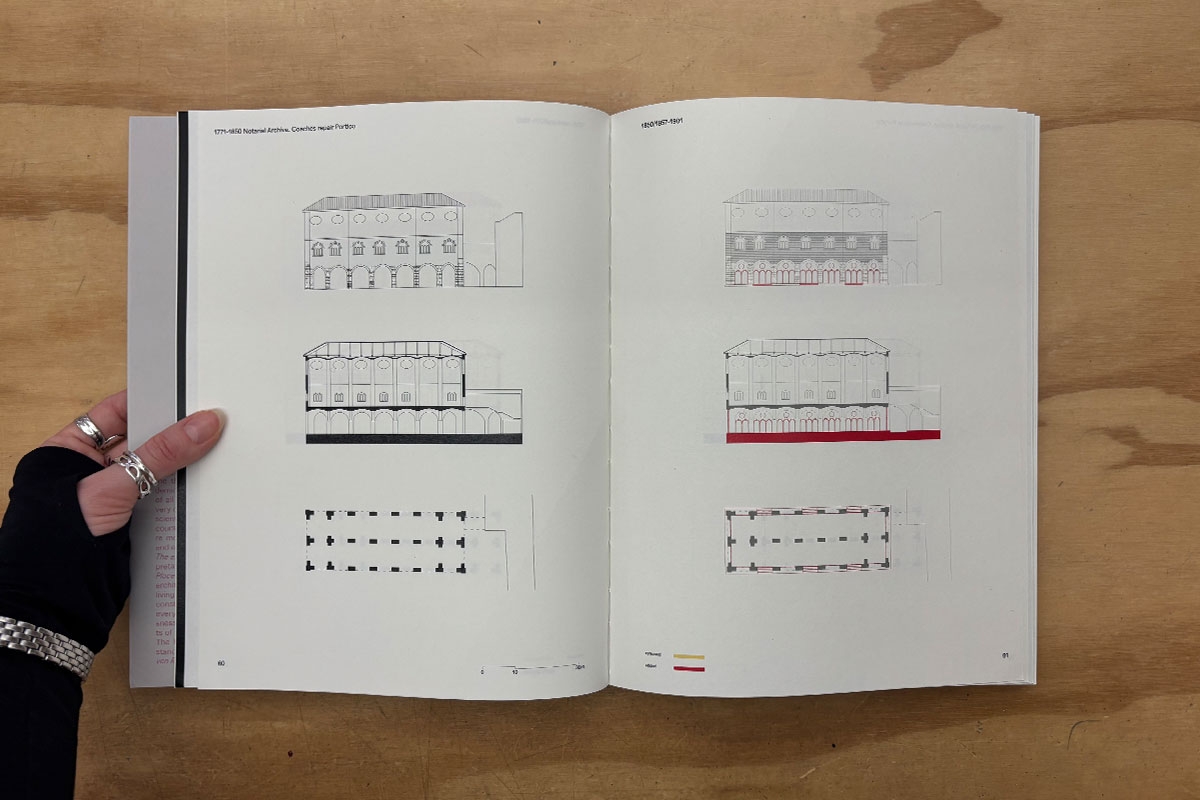
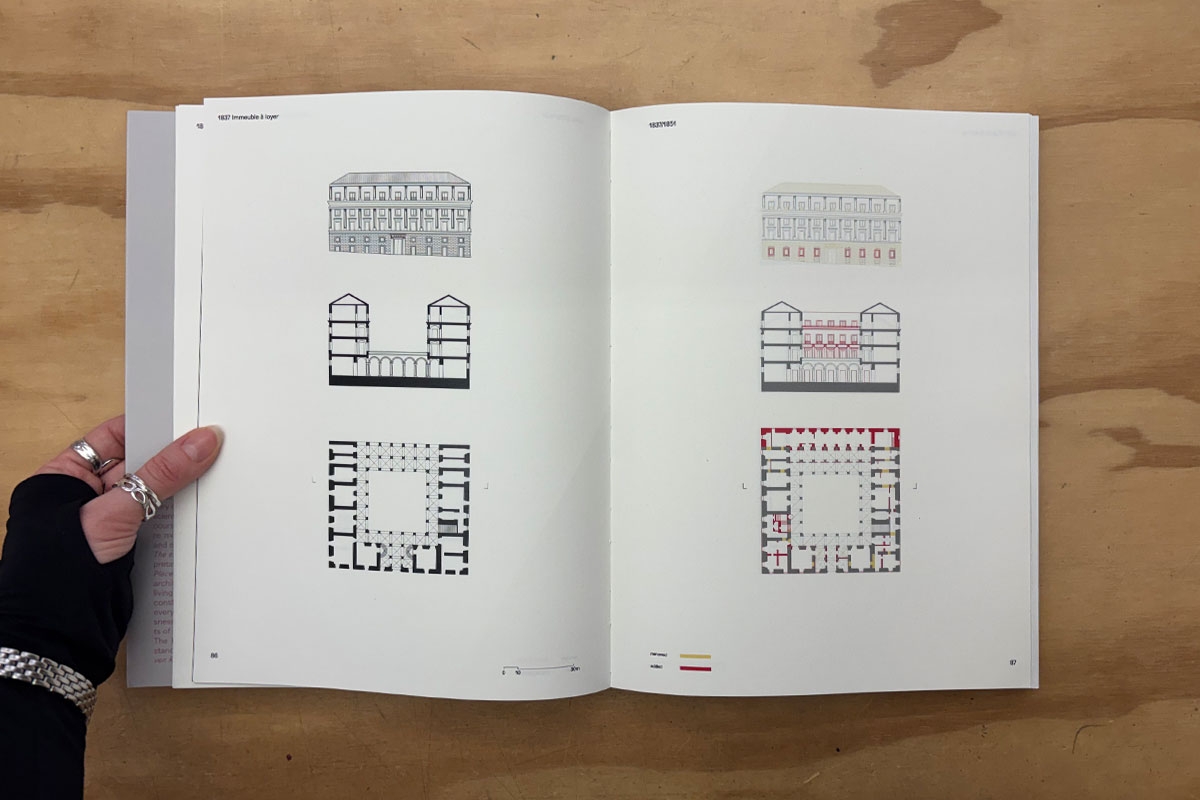
Architectural Affordances is a collection of drawings that trace transformations in thirty buildings over time. Organized into three categories based on time-periods and life cycles - centuries, over one hundred years, and less than a hundred years - the atlas gathers consistent floor plans, sections, and elevations that facilitate the study of Umbau as major and minor transformations of buildings alongside yellow-red plans.
These transformation, extension and redevelopment projects were compiled through a call for papers and drawn and assembled by international architects from both practice and academia. The resulting atlas not only depicts changes in the material composition but also presents the mediation of forms and functions as a temporally and socially conditioned appropriation of affordances offered by built spatial arrangements. What the constants of primary construction elements illustrate are a certain resistance to change, which can endure for centuries, while individual objects, non-load-bearing walls, surfaces, or furnishings, as well as the accommodation of specific uses, possess a more temporary character.
The interplay among these different time-periods creates gaps that we, as architects, bridge creatively through drawing. Therefore, architectural drawing plays a central role in the book not only as a form of notation for architectural ideas, allowing us to forge new/old bridges towards a theory of transformation, but also as evidence and recognition of the generative potentials of architectural types. As Typologies of Umbau, the gathered projects illustrate a familiar tension. Historical buildings seemingly align with architectural types – as formal structures or concepts of organizing forms that give architectural elements a recognizable order, allowing for centuries of diverse uses and adaptations. The potential separation of the building envelope from the load-bearing structure in modern construction requires the designer to make a further effort and challenge, both in terms of interpretation and autonomy.
Architectural Affordances is a collection of drawings that trace transformations in thirty buildings over time. Organized into three categories based on time-periods and life cycles - centuries, over one hundred years, and less than a hundred years - the atlas gathers consistent floor plans, sections, and elevations that facilitate the study of Umbau as major and minor transformations of buildings alongside yellow-red plans.
These transformation, extension and redevelopment projects were compiled through a call for papers and drawn and assembled by international architects from both practice and academia. The resulting atlas not only depicts changes in the material composition but also presents the mediation of forms and functions as a temporally and socially conditioned appropriation of affordances offered by built spatial arrangements. What the constants of primary construction elements illustrate are a certain resistance to change, which can endure for centuries, while individual objects, non-load-bearing walls, surfaces, or furnishings, as well as the accommodation of specific uses, possess a more temporary character.
The interplay among these different time-periods creates gaps that we, as architects, bridge creatively through drawing. Therefore, architectural drawing plays a central role in the book not only as a form of notation for architectural ideas, allowing us to forge new/old bridges towards a theory of transformation, but also as evidence and recognition of the generative potentials of architectural types. As Typologies of Umbau, the gathered projects illustrate a familiar tension. Historical buildings seemingly align with architectural types – as formal structures or concepts of organizing forms that give architectural elements a recognizable order, allowing for centuries of diverse uses and adaptations. The potential separation of the building envelope from the load-bearing structure in modern construction requires the designer to make a further effort and challenge, both in terms of interpretation and autonomy.